
The Symbiotic Origin of Cellular Decline: Deconstructing the Multidimensional Complexity of Aging
1Yury Romanov
1Sergei Vatolin
What are the examples of practical applications of Kolmogorov-Arnold if biology (models to which you can plug in variables)? If we need to pick a single most significant variable for all aging procceses, it most likely will be time.
Regarding the car example... The most often replaced parts of the car are brakes and spark plugs which have very little to do with oxidation, mostly friction and electrical errosion respectively. So even parts of simple mechanisms have different causes of aging.
Amiloids plaques are not ubiqutous among cell types, and mitochondria are (except RBC, plateleres and eye lense). How to explain this in light of your theory? Are there experiments confirming long-time survival of mitochondria in amiloids? How do mitochondria unfold proteins into amiloids?
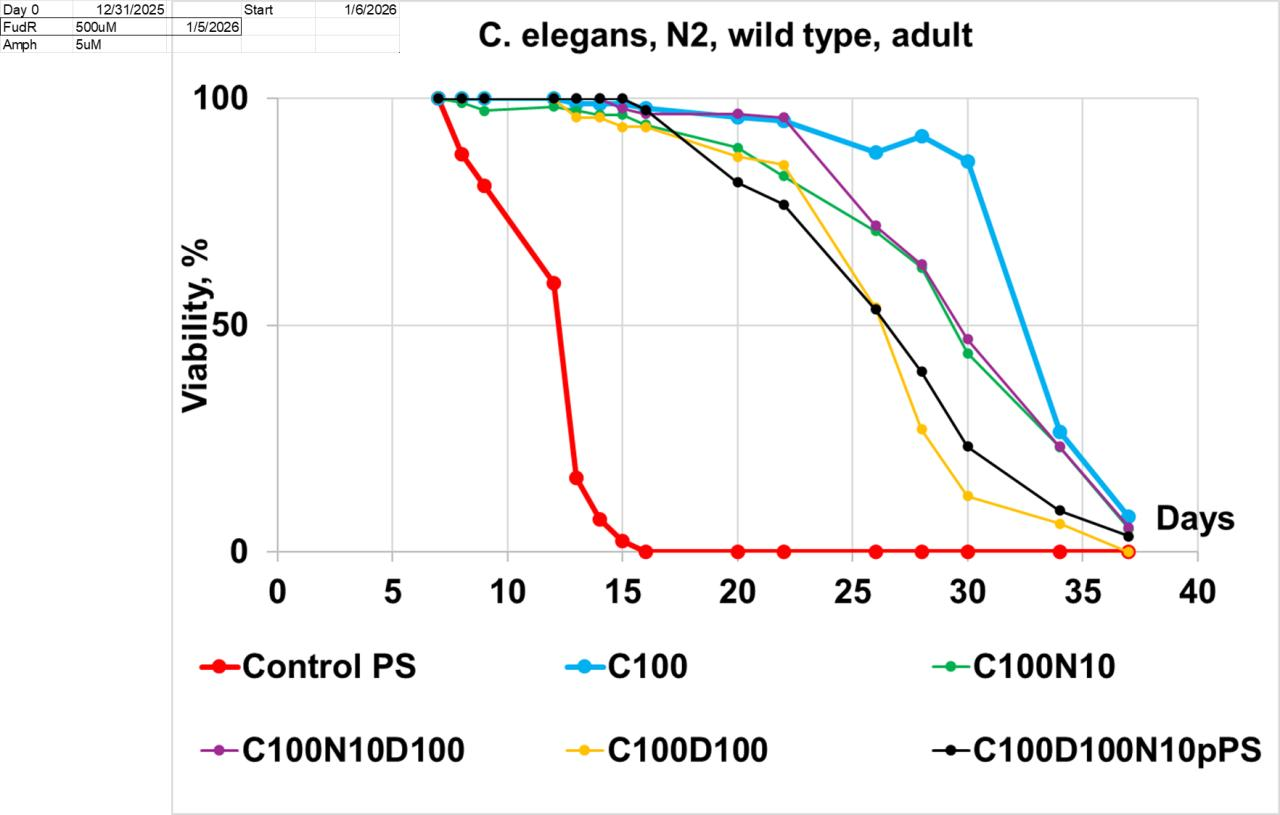
Which of your references contain the mentioned c.eleganis experiment? Without it the discission will be purely theorethical. I agree that replication fork collision is a thing, but not sure how major are its contribution to aging.
"Amiloids plaques are not ubiqutous among cell types" - amyloids, pro-amyloids are extreamly common in every cell type, in any animal, worm or mammals. Amyloids stem from bactrei cells, so-called inclusion body. I will place one more post later today on this issue.
Pro-amyloid proteins contain so-called "Internaly disordered domaines, IDD". Around 30-40% of the proteom (both eukariots and prokariots) has IDDs. Amyloid is a protein conformation with minimum energy, the most stable conformation, and the less active one.
It is the minimum energy = aged organism is at minimum energy.
Key words: amyloid, intrinsically disordered domain, biomolecular condensates
"practical applications of Kolmogorov-Arnold theoreme" -
Experimental proof of this statement:
Lab journal:
https://vk.com/wall-223616395_123
https://vk.com/wall-223616395_128
https://vk.com/wall-223616395_127
A Repurposed Monotheraputic Strategy to Counteract Aging by Modulating Mitochondrial DNA Dynamics
As the cell’s evolutionary concerved energy and metabolites source, mitochondrion is central to normal functioning of any cell, tissue or organism, making it a key target for pro-longevity therapies.
A critical aspect of mitochondrial biology is the competition between mitochondrial DNA (mtDNA) replication and transcription—two mutually exclusive processes. Evidence suggests replication dominates, creating a bottleneck in gene expression and energy production. Thus, even high mtDNA copy number may not ensure optimal function if genomes remain replication-bound.
This work proposes shifting the balance from replication toward transcription. By selectively inhibiting mtDNA replication, mitochondrial genomes may become more available for transcription, enhancing respiratory protein expression, respiration, and ATP production—without increasing mtDNA copy number or its associated costs.
We explore a class of small molecules capable of modulating this balance by limiting replication initiation and promoting a pro-transcriptional mitochondrial state, without destabilizing the genome. Preliminary findings are the substantial increase in chronological life span of C. elegans, from 100% to 150%.
This study investigates a combinatorial approach designed to reinforce this shift and improve mitochondrial performance. By targeting a core constraint in bioenergetics, this strategy offers a novel path to counteract age-related cellular decline.
These are N2 (wild type strain), adult worms (not dauer larva)
"The most often replaced parts"
I own three cars, I fix them myself, I know for sure that the rust is the most common reason of a car failure. Car body, brakes, wheal bearings, axels, exost (I replaced catalitic converte yesterday) , suspension, etc.
Many researchers—and non-researchers alike—are daunted by the sheer number of active molecular factors in biology, and in the molecular biology of aging in particular. Consequently, a rather popular view of aging holds that it is an intractable problem due to the multidimensional, multifactorial nature of the observed phenomenon.
The aim of this essay is to present evidence that the behavior of a multidimensional entity can be represented as the sum or superposition of biological functions that are less complex, or even simple, and defined on the basis of specific variable(s).
One approach to combating aging is based on the so-called "hallmarks of aging." It posits that the human body, its organs, and its tissues age in distinct ways, and that each physiological function requires a unique approach to slow, delay, or even reverse the molecular signs of aging. Human viability is conceptualized as a function f(x1,...,xn), which depends on a vast array of variables; a decline in any one of these may lead to a reduction in organismal fitness and, ultimately, death.
An even more extreme viewpoint suggests that every single cell requires distinct, and likely multiple interventions to mitigate the signs of cellular aging. This perspective has given rise to so-called "combinatorial therapies," which target various signs of functional decline across different organs. This viewpoint has also led to a curious, anti-Darwinian conclusion: that different mammalian species age in fundamentally different ways. Since this approach failed to address the underlying molecular basis of aging, even combinatorial therapies have failed to yield any substantial increase in the chronological lifespan of mice, flies, or worms.
Aging of Mechanical Objects. Our planet, Earth, is currently populated by machines, those found on land (automobiles, etc.), in the air (aircraft, etc.), and in the water (ships, submarines, etc.). From the perspective of "signs of aging," each mechanism ages and dies in a unique way. Entirely distinct components of these mechanisms slowly lose their functionality. Nevertheless, the entire diversity and complexity of aging in mechanical objects can be reduced to the superposition of several functions of a single variable: the oxidation of iron (the material). Virtually all mechanical parts (functions) today are manufactured from iron or plastic. It makes no difference whether a mechanical part originates from an automobile, a submarine, or a stratospheric aircraft. The actual, fundamental, molecular cause of aging in mechanical objects is a chemical reaction between iron (or other metals, or even plastic) and oxygen.
Conclusion: The complex and diverse aging of mechanical objects is explained, in practice, not merely in theory, by a single variable: a single molecular mechanism. The sum of various functions (such as a car engine or a ship's propeller shaft), all dependent upon this variable (material + oxygen), ultimately leads to the functional failure, and demise of the mechanical object.
A Single Variable. Most interestingly, this conclusion has already been thoroughly described and proven within the field of mathematics. It originated with Hilbert's Thirteenth Problem and subsequently evolved into the Kolmogorov–Arnold theorem. This theorem states that any multidimensional continuous function can be decomposed into a finite sum of compositions of continuous functions of a *single* variable, combined with addition.
The Kolmogorov-Arnold representation theorem (often referred to when discussing the Kolmogorov-Arnold equation) demonstrates that any continuous multivariate function can be decomposed into a finite sum of continuous functions of a single variable.
This means: Any function f(x1, x2, ..., xn) can be expressed as a sum of functions, each of which depends on only one variable.
Is this not precisely what I have been describing regarding the world of mechanical "organisms"?
A Biological Interpretation. Let us return to the "signs of aging." We can construct a molecular-biological analogy to the Kolmogorov–Arnold theorem: a regulatory network involving DNA, RNA, and proteins, serving to explain the fundamental molecular mechanism of aging. In any organism, any tissue, or any organ—regardless of that organ's or tissue's functional purpose.
Even if the regulatory process appears incredibly complex and multifaceted, there exists a method to decompose the system into simpler, single-variable modules which, when properly aggregated and combined, faithfully reproduce the behavior of the entire system. The Kolmogorov–Arnold theorem posits something remarkable: we do not need to comprehend the entirety of the multidimensional interactions simultaneously. Instead, these complex functions can be reconstructed by combining several simple responses from a one-dimensional regulator.
However, the primary challenge lies in identifying the specific biological factor responsible for all the "hallmarks of aging" across all eukaryotes, and perhaps even in prokaryotes. As stated at the outset, this sounds utterly impossible; yet, the Kolmogorov–Arnold theorem asserts the contrary: it is mathematically feasible, and this has been proven.
Allow me to present just such a mechanism. The assertions set forth below are grounded in empirical evidence.
Aging is a phenomenon observed in all eukaryotic organisms. Over the course of evolution, across a wide variety of habitats, eukaryotes have acquired numerous adaptive traits, which manifest as the multitude of functions ascribed to differentiated cells, tissues, and organs. This has led to the diversity of aging phenotypes observed in both multicellular and unicellular eukaryotic species, as well as to the formulation of numerous hypotheses regarding the mechanisms of aging. Although aging may be a universal feature of all eukaryotes, its underlying mechanism remains obscured by approximately two billion years of evolution. Consequently, a biochemical or cellular trait common to all evolutionary lineages could serve as a promising candidate for explaining the diversity of cytological and biochemical changes observed in various eukaryotic tissues during aging, as well as for targeting via direct pharmacological intervention.
Typically, aging cells are characterized by unbalanced mitochondrial dynamics, skewed toward a preponderance of punctate mitochondria. Genetic and pharmacological manipulations of mitochondrial fission-fusion cycles can contribute to either accelerated or decelerated aging in cells or organisms. Mitochondria originated from autotrophic alpha-proteobacteria during the early stages of eukaryotic evolution. To escape their host cells, dividing alpha-proteobacteria would initiate the lysis of the host cell; apoptosis is a product of this primordial program for the lytic exit of the symbiont cell. Over the course of evolution, the eukaryotic host cell mitigated the detrimental effects of these symbiotic proto-mitochondria; consequently, modern mitochondria are now functionally interdependent with their eukaryotic host cells, while retaining their own circular genomes and independent replication timing. An imbalance between cellular and mitochondrial proliferation generates intracellular stress, ultimately leading to a gradual decline in host cell performance and age-related pathology.
The basal mechanism of aging is the conflict between mtDNA replication and mRNA transcription. This variable underlies all biological functions manifested in cells, tissues, organs, and organisms with diverse physiological roles.
Thus, aging evolved from a conflict between maintaining a quiescent, non-proliferative state and an evolutionarily conserved reproductive program governing the life cycle of former symbiotic organisms: mitochondria.
There is a pharmacological approach that has been tested sucsesfully on C. elegans, normal human cells and some very preliminary data on mice:
Best,
Sergei Vatolin
1. Kolmogorov. On the representation of continuous functions of several variables in the form of superpositions of continuous functions of one variable and addition. Dokl. Akad. Nauk SSSR 114, 953–956 (1957).
2. Greenberg, E. F. & Vatolin, S. Symbiotic Origin of Aging. Rejuvenation Res. 21, 225–231 (2018).
3. Agaronyan, K., Morozov, Y. I., Anikin, M. & Temiakov, D. Mitochondrial biology. Replication-transcription switch in human mitochondria. Science 347, 548–551 (2015).
4. Pomerantz, R. T. & O’Donnell, M. What happens when replication and transcription complexes collide? Cell Cycle 9, 2537–2543 (2010).